Exam Review
- Select the letter of the organ with the following function: Muscular propulsion of materials into the esophagus.A)AB)BC)CD)DE)H
- Which muscles of the tongue are responsible for changing its shape for speech and swallowing?A)Circumvallate musclesB)Extrinsic musclesC)Salivary musclesD)Submandibular musclesE)Intrinsic muscles
- The letter D is pointing to the right lobe of the liver.
A 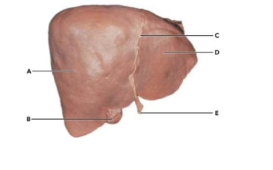 A)TrueB)False
- Starting at the pyloric sphincter, which sequence represents the correct path food follows?A)Pyloric sphincter → Jejunum → Ileum → Transverse colonB)Pyloric sphincter → Duodenum→ Jejunum → lleumC)Pyloric sphincter→ Duodenum lleum→ Jejunum→ Ascending colonD)Pyloric sphincter → Duodenum → Cecum → Sigmoid colonE)Pyloric sphincter→ lleum→ Jejunum→ Cecum
Exam Review
- Which of the following doesn't belong?A)Transverse colonB)IleumC)DuodenumD)Jejunum Villi
- True or False The pancreas is intraperitoneal and lies transverse at the level of L1 and L2 vertebrae.A)TrueB)False
- True or False Fungiform papillae contain about 50% of the taste buds and are located at the posterior of the tongue.A)TrueB)False
- A patient comes in complaining of sensitivity when biting into cold foods. Upon examination, you notice a chisel-shaped tooth appears slightly cracked. What type of tooth is this?A)IncisorB)CanineC)PremolarD)Molar
Exam Review
- Bile is produced by hepatocytes, and eventually moves into the portal triad's bile ducts, which make it way into the:A)Pancreatic ductB)Common bile ductC)Hepatic veinD)Gallbladder
- Peyer's patches, which house lymphocytes, are found in theA)EsophagusB)StomachC)Distal ileumD)Jejunum
- In the small intestine, the muscularis externa consists of two layers of smooth muscle: an inner circular layer and an outer _____ layer.A)ObliqueB)TransverseC)SkeletalD)Longitudinal
- True or False The serosa is present throughout the entire length of the alimentary canal.A)TrueB)False
Exam Review
- The enteric nervous system provides intrinsic innervation to the alimentary canal from the _____ to the anus.A)EsophagusB)PharynxC)StomachD)Mouth
- Blood supply to the liver, stomach, pancreas, and intestines is provided by branches of theA)Superior vena cavaB)Thoracic ductC)Coronary arteriesD)Abdominal aorta
- Organs such as the duodenum and pancreas that are located behind the peritoneum are described as ___.A)IntraperitonealB)RetroperitonealC)SubmucosalD)Parietal
- True or False Cholecystokinin (CCK) stimulates the release of bile from the gallbladder and pancreatic enzymes.A)TrueB)False
Exam Review
- The enzyme ___ found in saliva begins the chemical digestion of carbohydrates.A)LysozymeB)Salivary amylaseC)PepsinD)Salivary lipase
- The glottis is the opening to theA)LarynxB)PharynxC)EsophagusD)Nasal cavity
- The esophagus enters the abdomen through the esophageal foramen.A)TrueB)False
- The additional muscle layer in the stomach allows it to ____ food more vigorously than other digestive organs.A)FermentB)SecreteC)ChurnD)Absorb