Exam Review
- Use the diagram above to answer the following questions. Which letter indicates Wernicke's area, which is important for understanding spoken words?
A 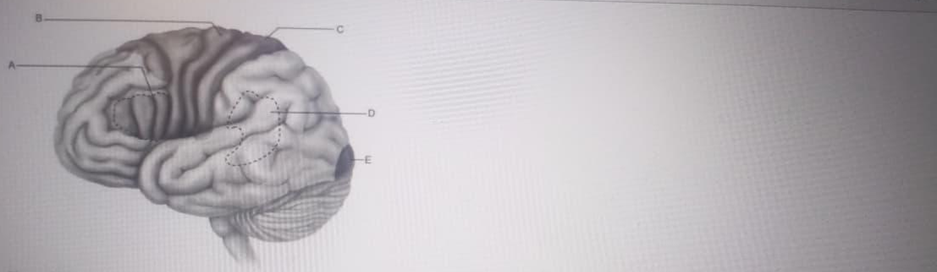 A)AB)BC)CD)DE)E
- Use the diagram above to answer the following questions. Which letter indicates the space where microscopic blood vessels and nerves pass through the center of the osteon?A)AB)BC)CD)D
- Use the diagram above to answer the following questions. Identify the letter that indicates the cardia of the stomach.A)AB)BC)CD)DE)E
- Use the diagram above to answer the following questions. Which letter indicates the integument layer that corresponds to leather hides from an animal?A)AB)BC)CD)DE)E
Exam Review
- The atomic number of carbon is 6. How many unpaired electrons are in its outer shell?A)TwoB)ThreeC)FourD)Five
- Use the diagram above to answer the following questions. Identify the letter that indicates the aortic arch.A)AB)BC)CD)DE)E
- Anatomically speaking, which bones compose the wrist?A)carpalsB)tarsalsC)metacarpalsD)metatarsals
- Use the diagram above to answer the following questions. Identify the letter that indicates the Epicranial aponeurosis.
A ✓ Correct 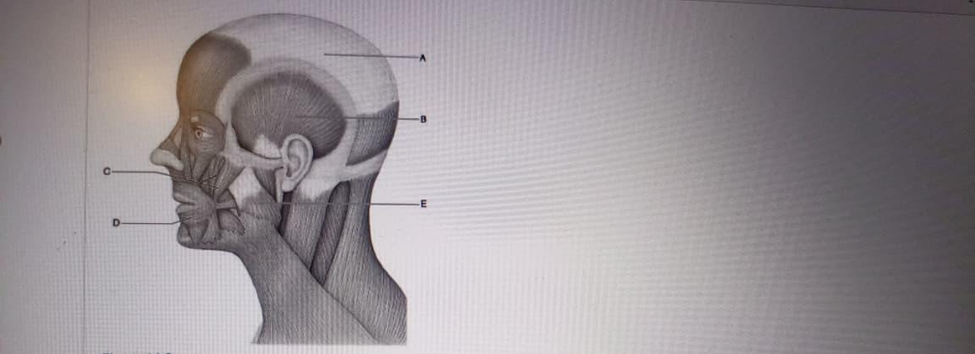 A)AB)BC)CD)DE)E
Exam Review
- During their residence in the thymus, pre-T cells develop into cells that proliferate as rapidly as any ▾ thymocytes in the bodyDropdown 1:Option 1: cytotoxic T cellsOption 2: antigen-presenting cellsOption 3: thymocytesOption 4: memory T cells
- The function of surfactant is to:A)transport oxygen from the air to the blood.B)transport carbon dioxide from the blood to the air.C)prevent each alveolus from collapsing as air moves in and out during respiration.D)trap foreign particles as they enter the bronchial tree.
- Use the diagram above to answer the following questions. Identify the letter that indicates the opening of the pharyngotympanic tube.A)AB)BC)CD)DE)E
- Which of the following minerals is essential for the formation of thyroid hormone?A)calciumB)ironC)copperD)lodine
Exam Review
- The lymphatic system serves various functions in the body. The two most important functions of this system areA)fluid balance and waste removal.B)fluid balance and immunity.C)immunity and waste removal.D)waste removal and gas exchange.
- In the right lung, the superior and middle lobes are separated by the:A)horizontal fissure.B)oblique fissureC)bronchopulmonary segments.D)hilum
- The fundamental organizational unit of life is the:A)atomB)cell.C)gene.D)DNA molecule.
- Use the diagram above to answer the following questions. Identify the letter that indicates the Serratus anterior.A)AB)BC)CD)DE)E
Exam Review
- The skin glands include three kinds of microscopic glands. They are the ▾ sweat, sebaceous, and ceruminous glands.Dropdown 1:Option 1: sweat, eccrine, and sebaceousOption 2: sweat, sebaceous, and ceruminousOption 3: sweat, eccrine, and ceruminousOption 4: sebaceous, eccrine, and ceruminous
- Use the diagram above to answer the following questions. Which letter indicates the mitochondrion?
A 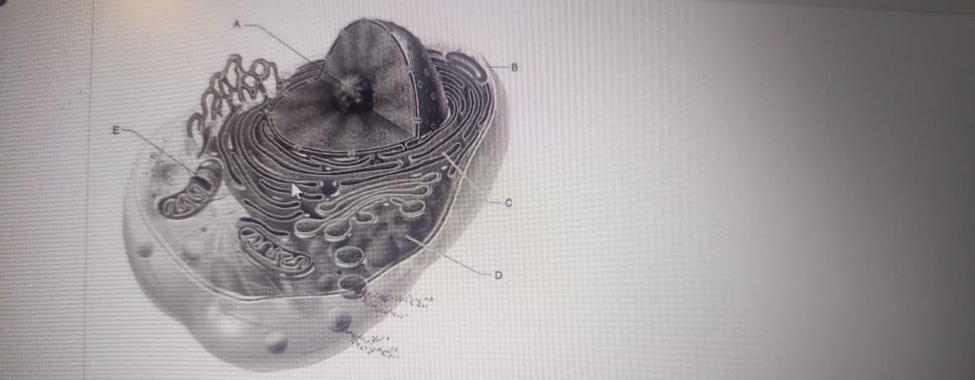 A)AB)BC)CD)DE)E
- The supporting structures in the male reproductive system include:A)the penisB)a pair of spermatic cordsC)the scrotumD)all of the above
- Largest purely endocrine gland in the body.A)hypophysisB)adrenal glandC)thymus glandD)thyroid glandE)pancreas